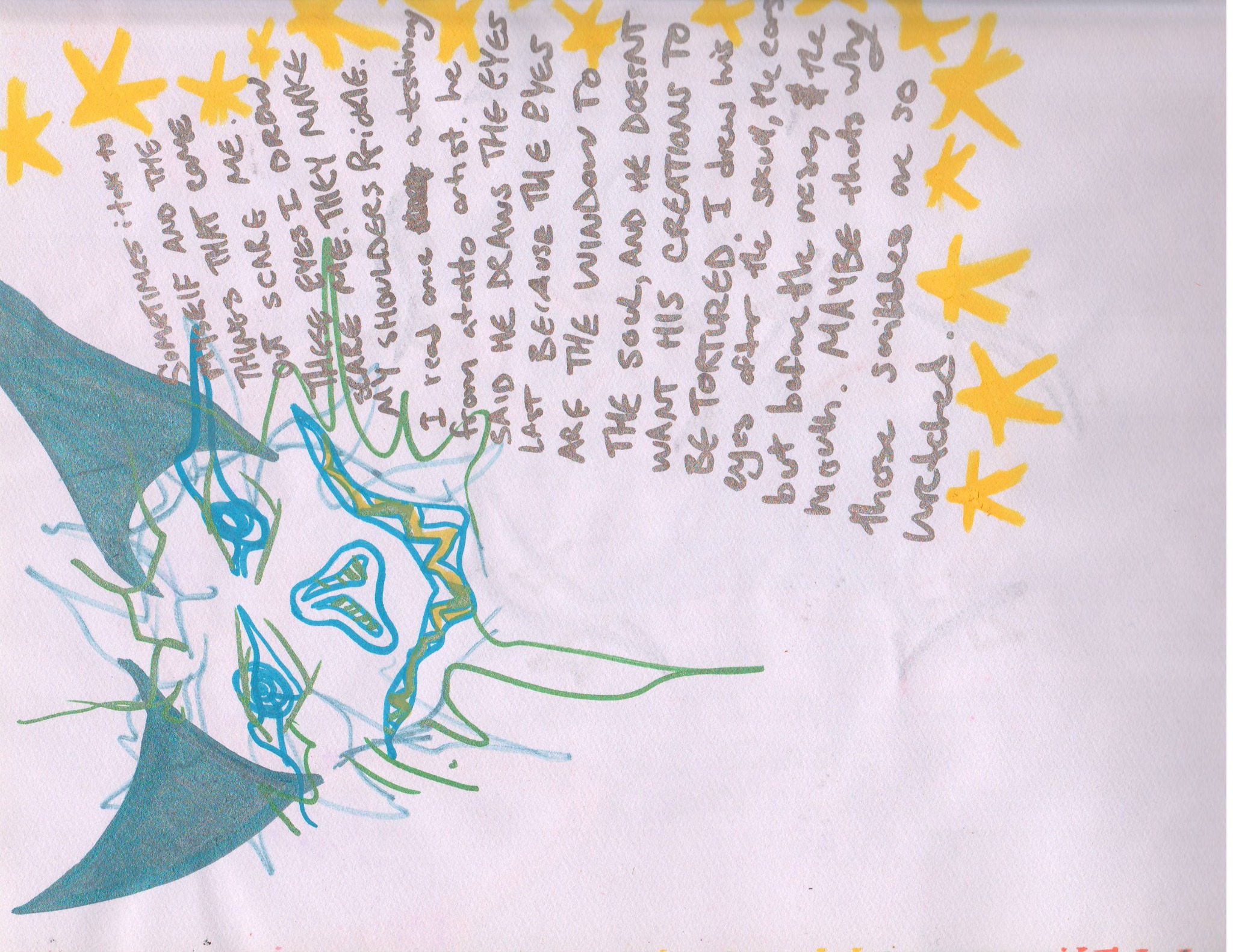
The Lingering Aftermath of Being Born A Daughter
I watched a video recently with my lip stuck to my gums. It was of a young woman
making a TikTok entitled My Mom Sober Vs. Not Sober. In the video, they showed a mom,
emotionally abusing and yelling at the children. In one, the mother screamed if the girl ever
stopped eating, the type of scream that older white women have, the one that almost seems to claw out of their throat and leave them choking, because she “just washed the dishes” and here she was again, eating. When she’s drunk, she’s loud, and abrasive, and still abusive, but laughing and dancing. She’s more palatable. It felt my skin peeling back from my nose as I watched, eyes glued to the montage. I hate meeting women like that.
Probably because my mom’s a woman like that.
I hate seeing myself in others.
The relationship between mothers and daughters is often one of anguish. This fact of
womanhood is undeniable. My freshman year of college, I wound up in the room of a philosophy student. We were only supposed to work on homework, but suddenly we were talking for hours in their room. They asked me about my family. I said I didn’t want to talk about it. I asked them about theirs. They said that they had a rough relationship, and gave me a wide stare over the rims of their glasses before continuing. They told me about how their parents were never really there, always leaving them out to dry. Then they rolled up their sleeves, leaned forward, and grinned. “One day, I was looking at myself in the mirror and I realized that I am my own mother and just like that, I viewed myself and my life differently.” I never spoke to that person that intimately ever again, let alone, essentially, at all, but the effects of that conversation still echo throughout the space between my bones; a philosophy I have tried to water and reap, but have come up
barren. Unfortunately, I am no mother, as many women aren’t. I suppose I’m no daughter, either, if I wound up with these thoughts in my head.
Many of the literary women studied within gothic lenses, and who hide in haunted
corners within the wider female literature sphere, are mirrors of this wretched pivot of mother and daughter, and in this essay I intend to dive into the intricacies of this dilemma–particularly, how and in what ways women will write characters who turn towards mothering themselves in the absence of a real one. We see it in the medical induced demon pregnancy in The Embodiment (Chung, B. 2021. Cursed Bunny) and the unwanted trash baby of feces and period blood in The Head (Chung, B. 2021. Cursed Bunny) The titles alone strike one as something separate and uncanny. Why is this? Both texts are tackling an unwanted pregnancy, and the unfiltered unwillingness the woman must cope with as the child grows and partakes in her resources. Let us break it down. To embody something is to represent tangibly an idea, quality or feeling. It is distinctly something that by all human measures should not be possible, nor tangible, being born because of human passion. When we think on the action of ‘to embody’ something, we think of putting on an act in makeup and clothing that is not our own; we think, in another sense, to fake something. A head: a part of the human body. Arguably, the most important part of one. Although, here, it is the head. It is addressed as such. The head, unattached, separate. How can this thing exist, all on its lonesome? The entire thing brings up feelings of uneasiness because of the intensity of the word choice. To embody. The head. They are separate, and they are parasitic. We know this before even reading either text.
Let us dive into this, and reflect back on how these daughters are, too, parasitic, as the
titles of both suggest already. The head, an undesired, unpleasant baby born of a mother who is set on destroying it all of its life, finds her doom at its hand, close to the end of her life. This comes about after the trash baby has finally achieved a desirable appearance, one that the mother can be proud of, and the two have a heated exchange about the way the head was raised. Bora Chung concludes the encounter as such:
The sneer faded from her young self’s face. With flashing eyes, her young self spoke through clenched teeth, but in a clear, slow, and restrained tone. ‘Gratitude. What gratitude should I have for you? Did I ask you to give birth to me, your indisputable offspring? You birthed me even when I didn’t want it, and did you not try at every turn to destroy me out of hatred and disgust? What have you given me to decide your feces and trash? I had to bear all sorts of humiliations and degradations to get what I needed from you to complete a human-like body. But now, it’s complete. This is the day I’ve been waiting for in that dark hole all my life. Now that I have become you, I shall take your place and live a new life.’ The young approached the old. (...) Lightly shoving the old body into the toilet, her young self closed the lid shut and flushed, (Chong, 18).
This encounter is one that is like many others highlighted in the feminine experience. Daughters will see the worst parts of their mother in themselves at humbling times. The way to fill that hole is, sometimes, sadly, through anger. The daughter sees the mother as one who has withheld, or who has changed them, and the feminine lens to this is to destroy.
This coily extension of mother and daughter in The Head and The Embodiment does not
end here. Both children in these tales are first and foremost unwanted. Both mother’s are pushed by expectations, from society and themselves, to handle their babies in certain ways. The head is unwanted, and is unloved. When the woman first sees the head, she flushes it, and when she sees the head a second time, giving it a better look, she describes it as “(...) About two-thirds the size of an adult’s head and resembled a lump of carelessly slapped-together yellow and gray clay, with a few scattered clumps of wet hair,” (4). They have a short discussion, where the head makes a plea to the woman to continue providing it with life, and the woman treats it with disgust and little patience. In a later encounter, the head tells her, “Mother, the state of your body has a direct effect on my appearance. This is because my entire existence depends on you.” In response, the woman “(...) stuck the pad smeared with her menstrual blood on the head’s face and shoved it down the toilet. She flushed,” (6). Everybody, everybody, in the woman’s life insists to her to simply forget about the head, and the parasitic relationship she has found herself in, resulting in our protagonist becoming numb and indifferent. We see her push this indifference on to her real, wanted, daughter, who we see spend her life doing the same, resulting in the two lacking a relationship into adulthood. Our protagonist gives into the heteronormative life of a pampered housewife for the stability of it all. Everyone wants her to forget about the head, to move on, so she does. This is not the hardest decision. Of course, she wants to do it. She never asked for the head, and it is much less socially acceptable than her wanted child.
If she could wave a wand and get rid of it, she would. The woman spends most of her life neglecting the child she did not want but who did not ask to be born, until she dies. In the end, she dies because the head becomes her in all senses physically. Arguably, the head takes after her entirely—mentally as well. The head has become the one thing it has ever desperately craved and openly despised with all of its being. That is how the cycle goes. You can not break how you were raised. It is the guilt all women must carry. The head is described as the better version of the mother. I believe this is the case. It is not because the head is younger. It is because the head had the time, and the mental capacity, to contemplate, all those years alone neglected in the sewer. The head knew what was wrong with her mother, how she was wrong, and in becoming her, the head now has the tools to do everything she wants. She has a rich new philosophy that is only truly birthed from the mother’s death. The mother is never granted the tools or time to truly reflect, and perhaps our protagonist may have turned around if other’s took the time to listen to her discomfort, but instead she reflects on her life as wasted. And can any reader blame her for feeling this way?
In The Embodiment (Chung), on the other hand, the child is unwanted, but not unloved. The narrator, like the protagonist of the Chung's other tale, is pushed by society in all sorts of directions, but all ultimately point to motherhood. She has a pregnancy brought upon by birth control pills, ones she was told would help her, and is confronted with little care and lots of prejudice when seeking assistance. The doctor, during the appointment where she discovers her pregnancy, immediately blames her, stating, “(...) It’s your own fault,” (26). At the end, they have this exchange:
‘You’re in a situation where you've become pregnant under abnormal circumstances, which means that if you don’t find a male partner, the cells of the fetus will not properly propagate or grow. You know how in grocery stores there are free range-fertilized and non-fertilized eggs? It’s the same thing here. If the fetus does not properly grow, then your pregnancy will not proceed normally, and this will ultimately be bad for the mother. Do you understand what I’m saying?’ Clearly, the doctor was annoyed with her. ‘W-what do you mean bad?’ ‘That depends (...) You better find a father for that child, fast. If you don’t, things will really get bad for you,’ (Chung, 22).
The egg example here is an important look into the way that these women are pushed into
positions they do not want to be, and brought down lower. The doctor, another woman, is a pawn within the system that represses other women. Hardened by the job of being a doctor, she has no time for empathy for the mother, who is so much like a chicken, and so very much not like her, because the doctor, unlike the narrator, would have done things, how do we say, right. She would have listened to her doctor, and because the narrator misstepped, it is up to the narrator to fix it, and fix it fast. It is her problem entirely and her solution must be swift, permanent, and correct. Everyone in the narrator’s life, down to her doctor, is uninterested in granting her empathy, or even personhood. Every action she must take for the next 9 months is for this baby, despite never actually having sex to have the baby in the first place. She is a victim, but no one views her as such. Even the old woman she meets on the bus who comes as a breath of fresh air into this woman's life, the one and only character to approach the narrator with kindness tells her, “‘(...) life goes on.
Think of the child in your belly. Live only for the child. It’s not easy raising a kid alone these days, but you’ve got to be strong and keep living your life!’” (36) It is the only thing she has left to do. We see the narrator whisked from date to date by her family, all ignoring her vocal complaints, eventually even setting up an ad with her phone number for a father. While this is occurring, the narrator feels like there is something wrong with the baby. She does not seem to be experiencing a pregnancy that feels accurate to what other women have described. This baby does not kick: not quite. She “(...) twist(s) or trembl(es),” (26) She goes to the doctor, who offers no advice other than to find a father for the baby. They do not give her the full facts, therefore not giving her the tools to take full agency over her body or life.
In the end the narrator fails to find a father for the baby and horrifically births “(...) a black and red, slightly iron-smelling, enormous blood clot,” (41). The baby spends its short existence squirming, searching for its mother blind, turning to the shocked silent medical staff, until in “(...) the next moment, the ‘baby’ disintegrated into a pool of liquid blood,” (49). Chillingly, the text ends with:
She covered her face with her bloody hands and began to cry. Sobs at first, soon escalating into full on wails. Whether they were tears of relief, sadness from losing the baby, or of something else entirely, she herself couldn’t tell, (49).
Ultimately, the narrator is afraid of this unwanted pregnancy. The reason she ever got pregnant in the first place was because she took too many birth control pills, something that was supposed to protect her. The woman has absolutely no agency in any of her choices up until her baby is born, and it is only after it dies that she is given her life back. She feels relief, it is the first thought that strikes her, but she isn’t supposed to feel that way. No woman should, should they?—and yet, we find women like Bora who write freely outside of this bubble of should and should not and allow themselves to feel these hard feelings. They allow for these feminine threads to run their course with their pens, until all that is left is the raw, mixed and unclear feelings and the reader is left with an odd sense of helplessness and confusion at what could have happened next. We do not know, she only exists within this lens of motherhood to us. Chung freezes these women in this ugly feeling, and leaves them there for us to digest.
I find myself needing to shift gears from Bora Chung's Cursed Bunny and allow some analysis into the world of Laura Sims's How Can I help You? (2023). Margo, one of the two woman narrators of this novel, certainly has earned her place in this hall of fame of women written by women who are dealing with this philosophy of becoming one’s own mother in the absence of a real one. Margo is a mirror in an autofictious sense for all the permissive women; she takes commonly held motherly or, at least, feminine traits and pushes them to disturbing and humorously relatable ends. We have all met the women who must always be right (Margo, for example, after a hostile encounter with a patron where she rips the book from their hands, concludes with: “The woman blubbers to Yvonne as I stand there, holding my prize,” (Sims, L. 2023. How Can I Help You? p. 149)) who are cruel under intense smiles (“I tried to let the laugh cleanse me,
to let it clean out my fear,” (94)) and make you question if the cruelty was ever truly there. The women who taunt, and power trip, and whose eyes sparkle in an off way when others seem to fail. Margo, of course, given the genre, pushes these traits to murderous ends–horrible, oftentimes, sexual murderous ends–and we must examine her in the lens of an exaggerated figure of womanhood. I will make it clear now that I have had the pleasure of meeting and speaking with Sims, and my interpretation that I am about to elucidate was not her intention with this novel. However, I am going to indulge in my findings of the text and pick apart the words to cement my analysis and prove to you, reader, why I feel this way, because the death of the author has occurred, as it will always. Let us begin.
Two facts of Margo are made expressingly clear of her from the get go: she is a child, but
she is also a mother. What do I mean by this? Margo begins her journey as a serial killer in
hiding. She herself frames herself as someone seeking solace, while the narrative directly frames her–and Patricia–as “(...) the Devil,” in the chapter head from the getgo. Do not forget this fact about Patricia, because it is deliberate. As for Margo—within her head— Margo is not the bad guy. She is a bad guy, but she is a victim first. She is “(...) like someone chased by demons across the threshold of a church,” (1). In discussion of her past, where she indulged in serial killings as a nurse, she describes her life going from hospital job to hospital job as joyful and whimsical, until, “Eventually, though, they’d start to look at me too long,” (8). She clings to little treasures, her delusions in her narrative. Margo is not simply Margo, but she is Jane, as well as an assumed list of other aliases, and thus she must constantly rebirth herself while repressing the ‘mother,’ which is to say, the first. To achieve Margo as a full person, Jane is lost. Another aspect of this theme I found compelling was this quote given the day after she is giddy from murdering someone for the first time in years: “I reply, resting a hand on my belly as I’ve seen pregnant women do. I do feel pregnant this morning: pregnant with what I’ve done,” (191). What a deliciously psychotic thing to say.
We see this rebirth, this erasure, this reframing of motherhood, constantly in Margo and her actions. In turn, Margo pushes the feminine to dangerous ends to make up
for a childhood that was severely lacking. Her mother, spoken of with disdain only, is alluded to being an alcoholic (reference How Can I Help You? page 39) and one who deserved the fate she received at (most likely) Margo’s hand. Margo's mother does not deserve redemption, and neither does Margo, for worse reasons, but she does not view it
this way. Only one daughter shall be served to the fire in Margo’s soul, and it is not going to be her.
Margo continuously pushes these motherly traits off to not only personify an aura of
pristine, but to also soothe herself. We see this in her constant and conscious cleaning. She baths, and she burns. She does this to preserve image. Each time Margo baths, it is for a “(...) reset,”(27) at the end of a long day. When she burns, it is to eradicate shards of her past. Margo herself puts these two things within the same category of her mind; in the place where Jane lives, occasionally coming out to say ‘hi, neighbor!’ and serves as a sticky resolve she must clean away constantly. She must repress the parts of her that are not Margo–and if she can not repress them, she must destroy them. This is a very important part of the ‘Margo’ persona, because it is the part that roots her destruction, and it began very young (You can find multiple allusions within How Can I Help You? where the implication is Margo set her childhood house on fire, thus beginning her murderous streak). “Sometimes, when the bath fails, the fire succeeds,” (28). These two
facets of cleanliness exist in a loop with the other. She is pushing the feminine to the destructive to suppress the first woman she was. Jane renews herself into Margo through a nightly ritual of burning and cleaning: the bath.
An additional angle to this proposition that Margo is pushing the feminine traits to be perceived as a full, put together person shines through with wanting to be orderly, and as a savior. To be orderly, she must be gratuitous with her patients–rather, her patrons–she must feel for them. She runs her library neatly and tightly. She can only be “(...) ‘seen’ in the safest way possible; they saw (her) as Margo,” (7). That means, being quick to save patrons from their trouble, flashing her beautiful smile, and having an infectious laugh, always. When she is questioned by Detective Parson over the death of Julia, an old woman who dies on the toilet in the library, she initially begins to maneuver the situation like the orderly, overly kind woman, but when that front fails, she turns to the emotional. She reacts “(...) shrill.”. When she is later questioned by her coworkers, she lets out a “(...) sigh, and make(s her) face sorrowful, and tears even come to (her eyes),” (86). Importantly, Margo thinks: “Because I do miss (Julia)—suddenly, forcefully,” (88). She forces herself into these boxes to what is appetizing to the consumer, because Margo is a tool. She is used to hide, rebirth, and deal with the unexpected, and thus her attitude can change in a heartbeat.
Necessary to this lens of her character is how she often views herself in a religious,
messiah-like light. She views herself as a savior. And she is incredibly prideful of that fact. We can see this at multiple points during the novel, but an instance that fascinates me is on page 139, after she tells Patricia a bit too much about her life, and in comforting herself, she is insisting on these traits in a rather intense manner. In her thoughts, Margo recalls, “(...)And the patients would have risen up out of their beds to defend me (...).” (166) It’s a rather horrifying look into her mind. She herself is unable to have one who should be her savior–her patients, Donna, her mother–and as such she decides to use her ‘daughters,’ these personas she wears and uses to live new lives absent, but never ending in their connection to her history, as saviors for others and for her future. She writes about this dichotomy in her own perspective, directly addressing herself as a savior, but this is really highlighted when she breaks her no killing streak and relapses with the slaughter of Friday Guy. There is much to unpack here, but a part I want to pay attention to is how she reacts after he dies:
After several minutes, I rolled off him and lay looking at the starry sky. Letting hot tears run from the corners of my eyes to the pavement. It had been so long since I’d felt such colossal satisfaction. I started to hum. I hummed a tune that came from my body and the night air. I was one with the night, one with the air and stars and sky. My body was weightless; it floated next to Steve’s. (Sims p. 187).
After Friday Guy is, firstly, gifted, finally, a name, he, secondly, brightens her stars, and they
“(...) brightened as (she) hummed (her) tune,” (187). The narrative reveals that she truly
does experience a religious encounter with her killings, where she saves someone’s soul from the horrors of their existence, it is shown she is filled with so much joy that she orgasms and hums in the aftermath of it. Often, this is something that you will see in religious individuals. In the wake of intense worship, one can be called to sing. This is something innate within you that demands to be let out. It is something that has been widely studied in theological spheres and it is fundamental to the religious experience, but that is a thesis for another essay. Still, singing is just as or more powerful than verbal or mental prayer. The orgasm in response to a religious experience has been widely depicted in biology and art (such as The Ecstasy of St Teresa by Gian Lorenzo Bernini where saint Teresa of Avila throws her head back in a silent cry of ecstasy). Margo, in her autofictious, female gaze, takes the task of caregiver to godly ends, and that does not go away. She, at the end of the day, can repress Jane, but not what Jane has taught her. They kill in exactly the same ways, despite Margo trying so hard to not fall into the trap of easy murder. Margo knows just because she can doesn’t mean that she should, but Jane has raised her on narcissism and cruelty, and Margo can not avoid her mother’s fate.
Within this thought experiment of characterizing Jane renewing herself like having a
daughter, we can not forget the crucial fact that Margo is not just a daughter but is, of course, a child. She eats cookies. She is childish and catty. She drinks hot milk like her mother gave her when she can not sleep. These sooth her. In fact, when Patricia sees these acts in front of her, she thinks, in an odd curiosity, “She’s having milk and cookies, like a child,” (168). For all of Margo’s growing up, she is, and always will be, a child yearning for some hollow attention. Attention she does, of course, get from Patricia.
Now, we must turn back to Patricia, our other devil featured in How Can I Help You? Patricia is a new worker at the library, working as a reference librarian, a failed novelist who is retreating back into the books in this small town to avoid her boyfriend and the ghosts of her past characters that taunt her thoughts constantly. Patricia is a different case than the other woman examined in this essay because she deeply loved her mother, and her mother died when she was young. She thinks of her mother only fondly, and she has a distaste for women who treat their children poorly. She, despite this love, is motherless. She has detached herself from the world, becoming an observer, of sorts, and she is the grandest of them. She is first attracted to Margo because she has something Patricia wants. She wants “(...) the warmth of what Margo has: the warmth of company, the joy of being known.” Margo also sees herself deeply in Patricia. “I want to look into her dreamy eyes and tell her: We’re the same. Gripped by a lifelong passion, grinding our souls against the world’s unjust demands,” (195). These women are forcing connections and they make one, but only one can survive.
Patricia easily cracks Margo’s facade, and keeps the truth of Margo’s past to herself,
close to her chest, deciding to entirely embody Margo and she writes Jane without even once knowing her herself, and she writes her perfectly. When Margo finds Patricia’s writings of her life, of Jane’s killings and of Margo’s slaughter, Margo thinks, “some details are off, but the essence of what happened is there, again almost as if she’d been watching,” (220). Patricia allows Margo to seep into every single aspect of her life besides physical until it entirely consumes her. These two have a very odd mentor mentee relationship, where neither one says it to the other. They are both equally disgusted and enthralled with the other. These mixed feelings accumulate in them in the basement of the burning library, a letter opener resembling a dagger in Patricia's hand. She has made Margo her source of life, the very person she seeks to impress, to become, despite all that she says and craves. Margo, from her own perspective, thinks: “(Patricia) starts to move. One baby step. Then another,” (232). Patricia describes this same act herself as a “(...) lunge (...),” (233). Margo, the muse, the life giver, the mother sees Patricia as a child, taking baby steps. Patricia, the artist, the copycat, the daughter sees Margo as an obstacle to take down. The two of them both crave the same thing from the other; a sense of fullness. In the end, Patricia, quite expertly and arguably uncharacteristically, kills Margo, and leaves her in the burning library, and, in the end, embodies the role Margo has left behind. She is full of positivity, becoming the savior. She even steals Margo’s telltale saying, calling the patrons, “(...) shell-shocked. The poor souls,” ( 237). It is undeniable that the mentee has become the master. This ending is one that is inevitable. Margo and Patricia exist as wretched mirrors to the other, because Margo has given Patricia all that she is. In the end, she dies, leaving Patricia to pick up the pieces, and she can only hope Patricia will do it right. The text implies she will. She must walk forward and fill Margo's shoes, so she shall, in any sacrifice necessary to make this change work.
And as I walk down the street, watching the sticky smoke of the cigarette leave my
cracked lips, I think of all that I have experienced with my own mother. It is simple to say we are a product of our environment, a solution to the end of an equation, but I find myself needing to turn to literature to find some humanity in this. Something to truly unpack. There is a horror of womanhood that I am afraid of expressing out loud, but feel free to write endlessly behind the walls of autorealism. I can let these feelings run. I can freely speak of the anger I have towards my mother, and I can write of the anger she has towards me, because I am her. And she is me. The head does it. Margo does it. Patricia does it. And the woman with an embodiment does it, as well. The Greeks wrote about this phenomenon long before I was even a thought, a speck in someone’s eye. We can gain a lot from turning to the women who do not press ‘pause’ on their thoughts, and I intend to continue tackling this subject matter.
0 Comments Add a Comment?