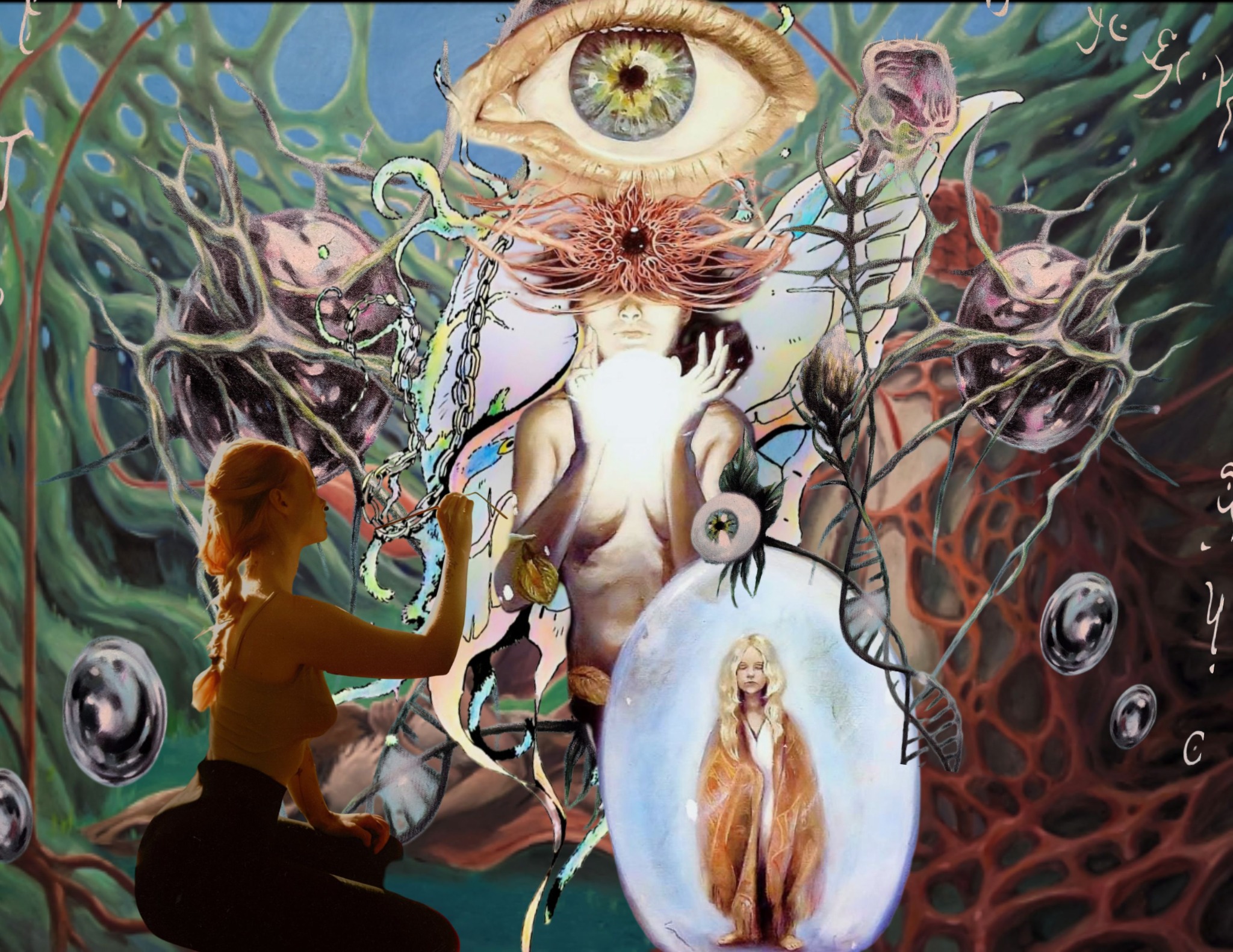
An Interview with Henrika Kurkimäki | Creator of Oracles of the New Wildnerness
I stumbled across a very fascinating Instagram account this past June. I was scrolling through reels, trying to find some sort of serotonin boost I guess, and I found this lovely woman talking about her new comic called Oracles of the New Wilderness. She drew me in with her surreal and intricate art and fascinating character designs. I become one of the first followers.
Since then, I have had the honor and amazement of watching the account grow over just a couple of months to 4,056 followers (and counting!). As an emerging artist myself, I am finding myself fascinated in why others create, and why they create what they do. I decided to reach out, shoot my shot if you will, and see if the creator of the account would be interested in discussing some ideas I had with her new comic. To my joy, she said yes! I compiled these questions for Henrika over the course of reading the first chapter of her comic. The interview was conducted through emails and across different platforms, which I believed allowed both of us to flesh out our responses and care for the work.
Be wary, there are perhaps light spoilers about themes, location, and what to look for in coming chapters!
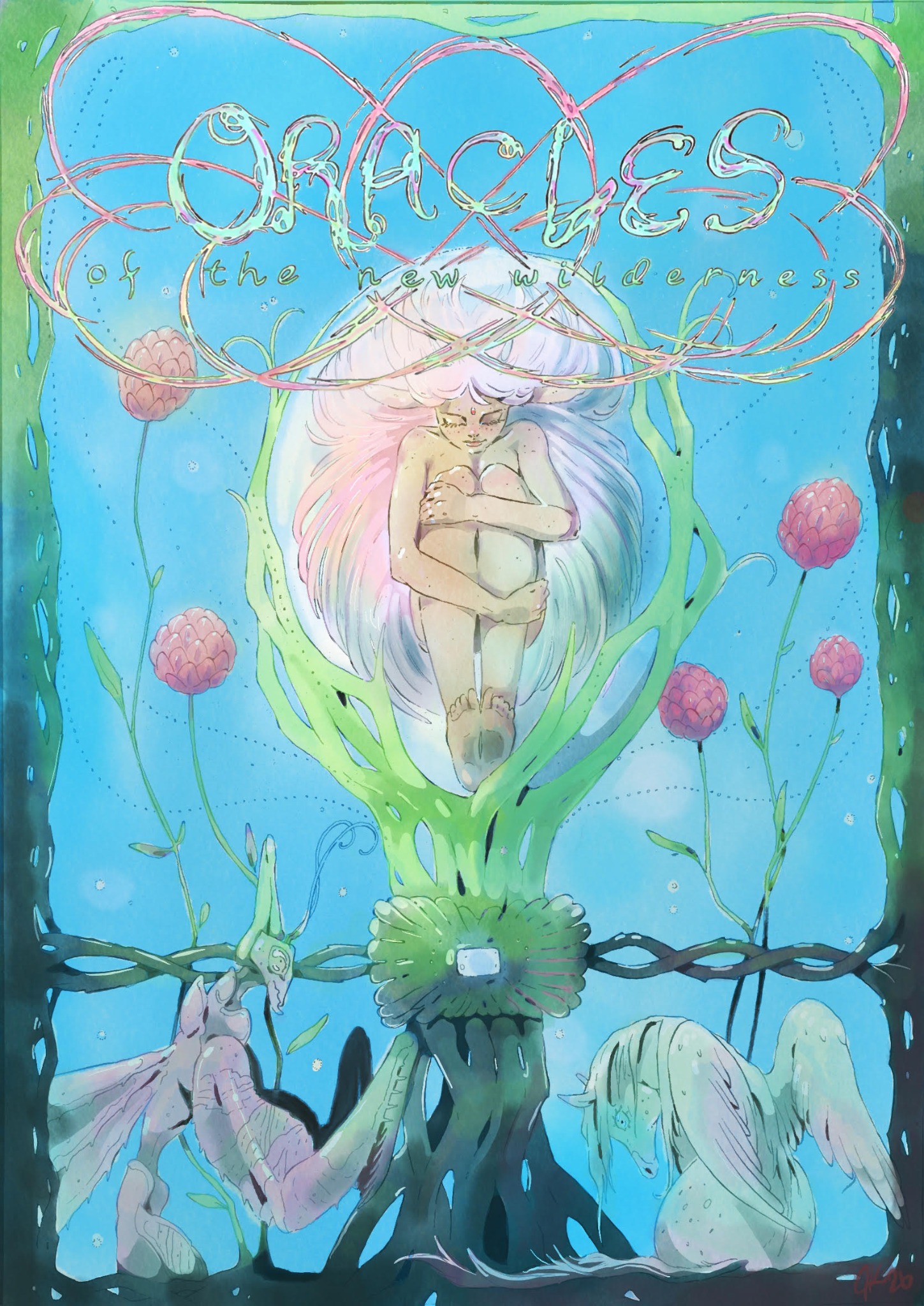
Brandi: I think we should start with some basic geography. Who is Henrika, the creator of Oracles of the Wilderness? What brought you to this stage of creation?
Henrika: My name is Henrika Antonella Kurkimäki, and I was born in Helsinki, Finland. I went to primary school in Finland, then my family moved to France; then Norway, where I went to IB high school; then I took a gap year as an au pair in England; and then went to Stockholm to study Linguistics at the uni, and dance contemporary. I lived in Stockholm for many years & my family still lives there. A few years ago I moved back to Finland on a whim, and started my small businesses as an energy healer (@henrikarcana on Instagram), tattoo artist (@avatarupgrade) and painter & illustrator (@yumereality). I even lived at an atelier for a few years, working as an art school model there, being paid in classical art lessons. I've always had music projects at the side as well (which you can mostly find at soundcloud.com/henrika-kurkim-ki ), and have been most inspired by movie soundtracks, which is why I really wanted to make one for each chapter of OotNW as well
Brandi: Hearing that you have been most inspired by movie soundtracks is really cool! I feel similar in some ways. I don't think that I would have ever become a writer had music not existed. Music always sets the tone for most of the writings I'm working on. What soundtracks do you find the most inspiring? What ones do you find yourself coming back to?
Henrika: Exactly! My first soundtrack-love was The Village -soundtrack by James Newton Howard and mostly played by the incredible Hilary Hahn. It's so deeply touching, beautiful and eerie. The soundtrack for Jane Eyre (2011) by Dario Marianelli, featuring violin soloist Jack Liebeck, is equally important to me – and so is the movie. Also anything, literally anything, by Colin Stetson I'll play on repeat. The soundtracks for Akira & Ghost in the Shell are also super good. And of course Enya for Lord of the Rings - the ten-year-old me just wanted to sing like her and that's why I even now always go for the mermaid vocals in my music.
Brandi: Immediately, and without reading much, I'm getting Brave New World vibes. The incubators, the mechanical hearts, the way the people discuss being people...how has classic speculative work shaped your narrative? Or has it not?
Henrika: Actually, I haven't read much sci-fi literature at all. I've always been reading a lot, but mostly fantasy novels, magical realism, or more like antropological/archeological novels about code-breaking the mysteries of old civilizations (which definitely has inspired this story a lot as well, as is apparent). I'm actually originally a Linguist, but turned into arts, because the research-world was not as free and mystical as I'd imagined, and I always made art at the side anyway. But the way of thinking I learned as a research assistant & writing my own thesises definitely left a mark on how I come up with stories and probably also why I always end up writing sci-fi. The visual landscape has been affected by years and years of looking at concept art online, watching films and anime, and of course spending infinite hours in nature. But a lot is directly based on my synesthesia (which I'll maybe dive more into later) & dreams, too. The incubator scene is actually a reoccurring dream of mine, but in the dream the people in the pods are saved.
Brandi: Oh whoa! That's so fascinating. Can I pick apart your dream a bit more? Do you find yourself often having vivid dreams? I have always found myself dreaming in different "towns," as I call them. They're not quite reoccurring dreams, but rather reoccurring places. I absolutely take my dreams with me into different steps of creation. Do you find yourself doing the same? Or is this a special instance?
Henrika: Yeah hundred percent. I definitely also have reoccurring places in my dreams, I love that you do too! Maybe it is how a creative brain organizes itself? Super interesting. My dreams often feel like other lives. I remember telling myself as a kid: “When your real life feels like your dreams, you've entered your dream-life”. It became my mission, and these days I do feel like the same atmosphere exists in my day-reality as in my dreams. This feeling of anything being possible and nothing being too real, but the experience of it still being increasingly vivid and rich. All the emotions are present, and there's always a sense of this oddly melancholy uncertainty, which I really love.
Brandi: Speaking of dreams and landscapes, this world feels very fleshed out and specific to me, and I can't help but wonder, is this really a story you've only been working on for a few months like you've said before on your socials? When did you *really* start thinking up this project and what was the real catalyst for it?
Henrika: I'm a multi-synesthetic, so all my art/what I create is like an internal symbolic alternative reality, like a dream, synesthetically converted from what I experience in my personal life and the world around me. A half-utopian, primordial post-apocalyptic world is very much a wish I had for myself, when I started unraveling and healing my own trauma-reality and limiting beliefs. It's a world carrying the feeling I hoped to experience once I'd dug myself out of the coffin of everything weighing me down since childhood. Also, for the past couple of years now I've been working with the national nature conservation association in my country as a visual artist, a writer and panelist, and I was frustrated and disappointed by how little I could offer and how small of an impact I had, compared to the vastness of my passion for it. So everything I tried to channel to those projects, kind of naturally took their place in this graphic novel story. So you're definitely right, a lot of this world has been passively and actively forming within me for over a decade, but I didn't know where or how exactly to channel it. Then this marketing manager reached out to me pitching a nostalgic, whimsical graphic novel project, and suddenly this entire world, story and themes just sprang out of me in such a complete form that I just had to go for it. But pretty soon the manager stepped away from the project, as she realized she wouldn't be able to keep up with it in the end. By that time my entire soul was so involved, that I just had to keep going on my own. And that's when I started the social media, drawing the novel itself, created the main characters, the backstory of the humanoids, and other details.
Brandi: Does the year 2502 mean anything?—The month July? Or was it something more random and far off?
Henrika: July was specific for me, since I started drafting the first chapter in July (2026). I knew I'd project those vibes into it so I just went with it. The year 2502 was not numerologically specific or anything – I was more so thinking it in terms of like, a turn of a century always bringing about this subconscious shift in philosophies and beliefs in people. We kind of expect something new to take place. And in the story it has indeed: they've been planning this new project for a while (mapping & investigating old-world-ruins that radiate frequencies/beliefs/ideas that might be harmful for the new ecosystem), which is the red thread of the story, and it's just been put into action when the story begins. Also, I thought that around 500 years is a realistic time-frame for the world to change that much – I mean around 500 years ago the world changed drastically due to the dark medieval times evolving into the renaissance. So I thought that maybe something similar would happen around 2500. Like a time of darkness and destruction turning into a sort of eco-renaissance.
Brandi: What role does God take up in your work? Does God mean anything to you at all?
Henrika: I'm very much an agnostic, and Christianity or a singular God is a symbol for me as much as any other central character that's been shaping the Western civilization. When I use the word God/god in the story, it's not so much my idea of a higher deity, but more so what I'd imagine the characters feel about it as a symbol within their individual psyches.
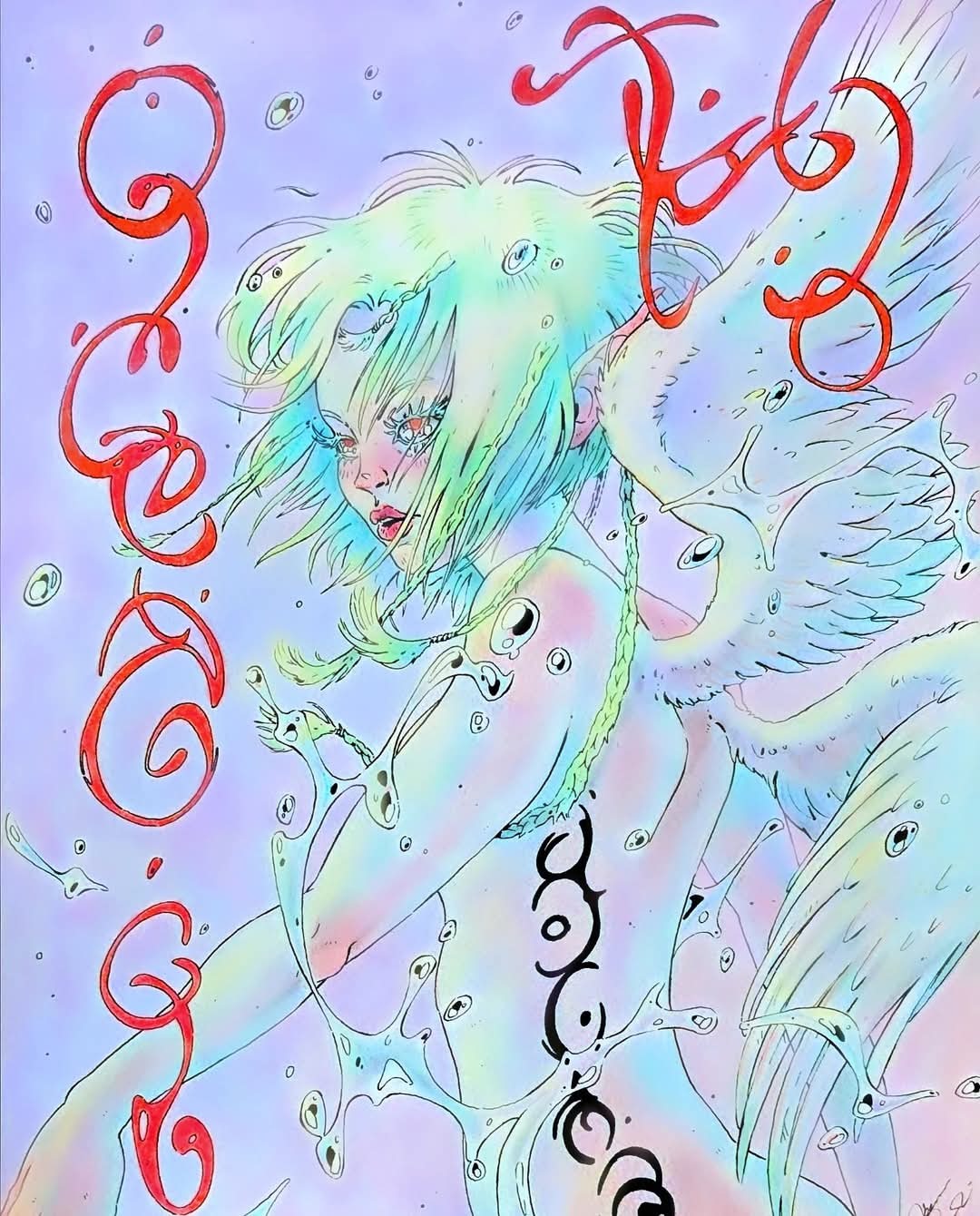
Brandi: What parts of this story are inspired by the current ai crisis? And—What does the ai crisis mean to you? I've always been a firm believer that if we must use AI, there must be strong legal protections for everyone involved, including the robot. We can't play god and then revoke their voice. How do you feel about this?
Henrika: I'm not trying to dodge the theme of AI at all. The Gadget and its “character” will definitely organically project a lot of the AI- and smart phone discussion into the story. Valeria is immediately very attached to it, and anyone watching the symbiosis forming, might argue just as strongly against it, as they might argue for it. There are definite benefits for using and protecting the Gadget, but it's just as easy to justify that it's a human made moralless parasite that should be destroyed now, and not later. The Gadget is channeling deep wisdom directly from the most ancient elements of the Earth that make life possible in the first place, without having any idea what that wisdom means. So it has no filter of its own to regulate what to channel, because it was built so that humans would've access to every bit of wisdom the Earth carries. And that of course is a recipe for chaos in itself, just like AI might be. But Valeria's character is so deeply instinctive, that even though she knows her role as the host of the Gadget might not be “good”, she takes it without a doubt, because her entire soul tells her it's her task in the ever-evolving ecosystem. So I sort of want to give a space for us to discover and mull over these very conflicting ideas and characteristics of an AI- or external brain-like character.
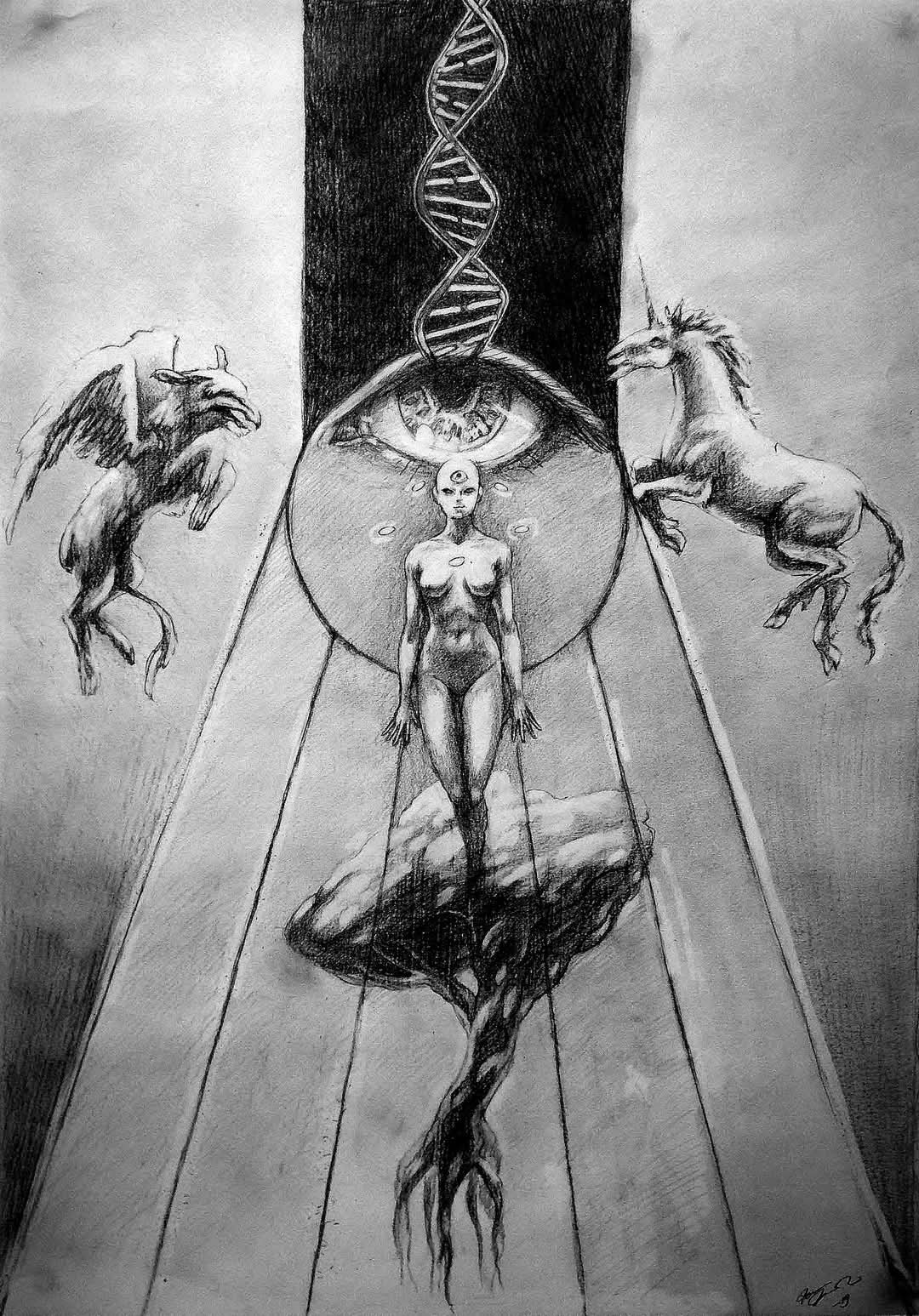
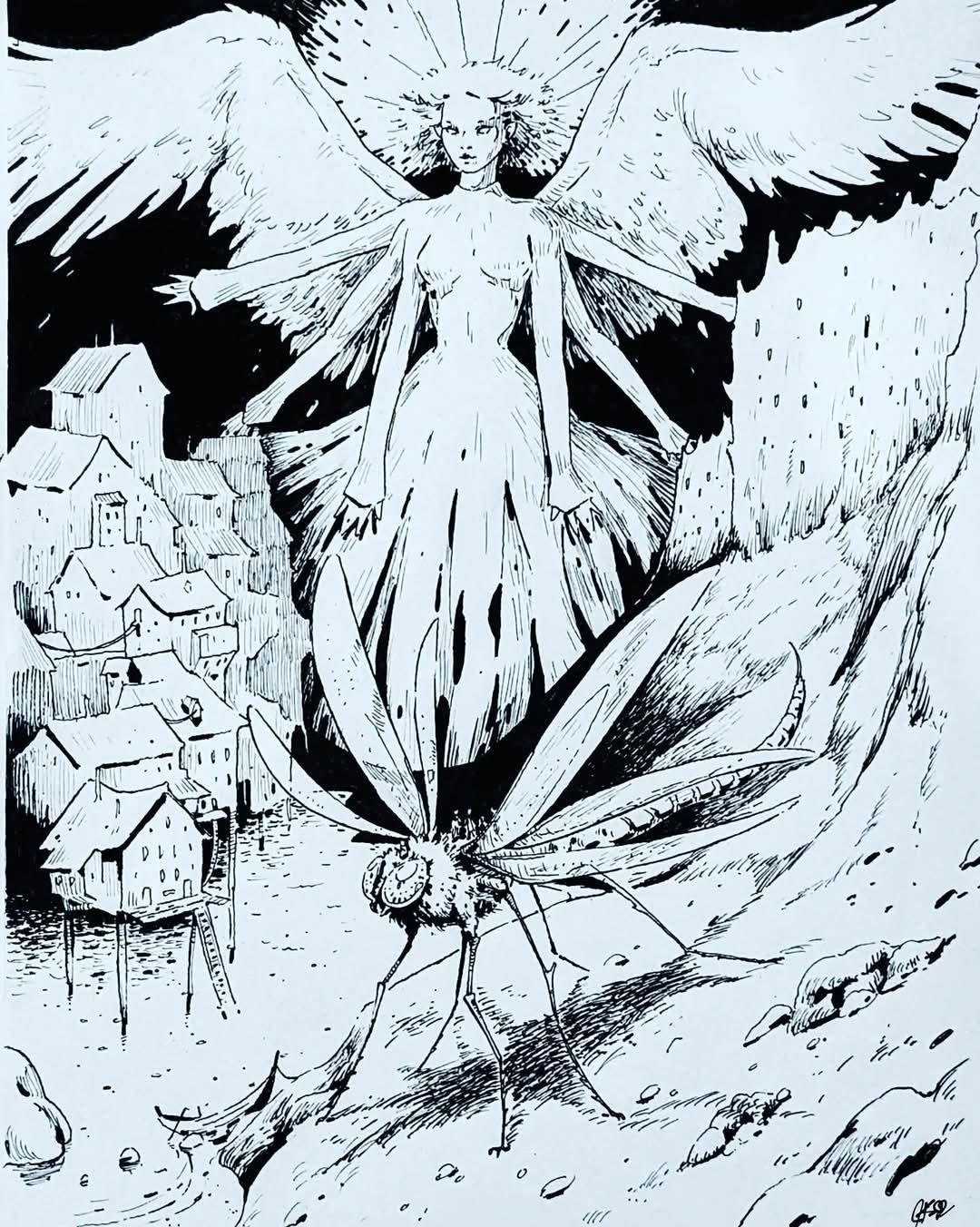
Brandi: A dystopian world that finds humans under the hierarchy of insects, and their fears, is really very fascinating. What were some of your inspirations for that concept?
Henrika: Miyazaki's Nausicaä has definitely had a big impact on me. It brings me hope knowing that there's an an artist of his caliber, who cares about the nature, insects and sensitivity so much. Also ever since I had my "spiritual awakening", when I was around 20 years old (trying to desperately heal from anorexia and persistent migraines by meditating, daily yoga, being in nature, writing my own stories etc), I became very fascinated by insects and their peers. I started helping tired bees and bumblebees, I'd interact with snails and noticed how intelligent they were, I'd make deals with spiders at home. I just have this intense love for them, and kind of believe the Earth is their planet. So in the story, the humanoids have realized they should just listen to the insects (who've now grown in physical size again due to surplus of oxygen) instead of fighting them for space and resources as humans always have, if they want to survive as a species. And the interesting hierarchy formed by this choice is, that the humanoids are to work towards preserving the insects, instead of themselves. It's almost as if right now humanoids are on trial period in the new ecosystem, and going solo in their choices might cost their entire species, since the insects monitor very carefully, who's helping the ecosystem evolve towards the common good enough, to be worthy of resources and space.
Brandi: I can't wait to see how this story evolves and explores the world of these characters deeper! Any threads we can expect?
Henrika: I'm so glad to hear it! One of the main themes is definitely the connection between emotional processing and thriving Nature. Kind of showcasing, how growing towards one's own truth felt deep beyond the mind or body – regardless or perhaps even because of apparent friction or opposing beliefs and intuitions – equals growing into one's unique purpose in the ecosystem. That's why I also focus on platonic love, rather than romantic, in this story: I feel like in its multidimensionality, it allows more space for the participants to evolve into their true selves and feel their own core. The emotional realm is the language of one's own core. And through that, I hope I can kind of... suggest these organic frameworks, for especially young people, to process their emotions in ways that feel natural, safe & connected, instead of isolated. In this futuristic but also primordial culture of humanoids, there are no taboos or rules as to when it's a good time to cry or sit with your emotions – in fact it's crucial to the health of the entire natural ecosystem, that they process their emotions in real time, prioritize co-regulation, and avoid accumulating shame around emotions. So there are and will be many moments when immediately after a distressful situation, they hug each other and cry out the stress, simultaneously wording what they experienced. This way they're able to accept change quicker, adapt and evolve instead of clinging onto something that is supposed to die or transform, and support each other and the natural world around them in the process, even if it looked different for everyone
You can follow Henrika on her artist journey by subscribing to her Patreon, linked below. Chapters 1 and 2 of Oracles of the New Wildnerness, out now!

0 Comments Add a Comment?